

AI
10 Aug 2026

The purpose of a monitoring system, meaning the means, organization and culture of the company devoted to structured strategic intelligence, is first to anticipate threats and opportunities, then to disseminate useful, qualified and recontextualized information to decision-makers for informed decisions. In times of crisis, such as we experienced at the beginning of 2020, the monitoring unit can be of decisive help when it comes to making decisions at the height of the crisis, but also in detecting new threats, possibilities of relapse, and of course opportunities.
Companies with an effective monitoring system will be better able to manage the crisis and will be quicker to return to a so-called normal phase.
In this article, we explore the contributions of the monitoring unit to crisis management.
Crisis modeling works show us that there are several distinct phases and a reproducible crisis kinetics.
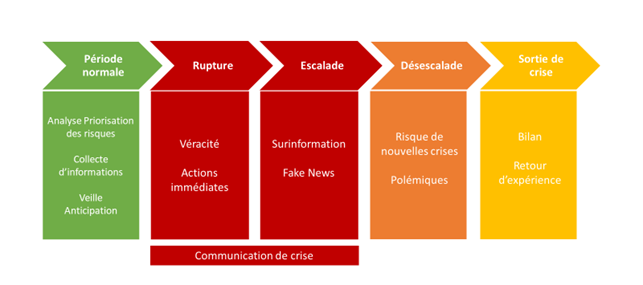
Throughout the pre-crisis and crisis periods, information governance is crucial: without it, the manager leading the crisis unit is operating blind. Information governance in crisis management therefore requires a well-oiled organization, effective information processing and dissemination.
Validated and reliable information is essential for crisis management. To achieve this, a crisis management unit must have people dedicated to collecting and processing information. This “information” unit is distinct from the monitoring unit that already exists outside of a crisis. This unit will process, filter and disseminate information related to the crisis. This data is essential in two ways:
Like a lighthouse and its keeper, the “information” unit is responsible for information governance.
Knowing how to process information means having a crisis organization in place, which shortens access to crucial information and the unit’s response time. A crisis clouds our ability to act calmly. The goal is to lift this cloud with a rapid process of collecting, processing and disseminating qualified, verified and contextualized information.
“If Generals can’t without good intelligence, why should CEOs think they can?”
– Marcel Van Beckel, DSM Company 2005
Poor crisis management and information handling can aggravate a crisis. In 2010, an explosion on the Deepwater Horizon oil rig, leased by British Petroleum, caused an unprecedented oil tide. It took the British oil company nearly a week to respond proactively to the crisis.
Tony Hayward, the group’s CEO, was then appointed to lead the crisis effort. He took some unfortunate decisions that exacerbated the crisis, examples of which include buying keywords on search engines as well as making some ill-advised public statements.
Two indicators show that the company was not prepared for this crisis:
A crisis must be addressed as quickly as possible to prevent others from taking control of the situation. Putting someone who is inexperienced in crisis management in charge reduces the group’s room for maneuver.
Without crisis organization, with job descriptions, clearly defined responsibilities, and information governance with a short and secure validation process, the crisis unit risks being overwhelmed by the influx of information.
When a crisis hits, it’s often fast and unexpected, but there are signs you can spot with strategic monitoring. These signs let you know when pre-crisis monitoring needs to switch to crisis monitoring to keep the steering committee (where decisions are made) from getting paralyzed. So, managing information during the incubation period is totally crucial.
How can this be done? During a crisis, the amount of data transmitted to the crisis unit is immense. The primary role of the crisis unit is to resolve the crisis. If this unit has to simultaneously process this external flow of unqualified information, search for internal information, and prioritize information, it risks neglecting its main prerogative of monitoring the crisis.
The information unit acts as a firewall and ensures effective information governance. It will have powerful information processing and analysis tools at its disposal, enabling it to be responsive and more comprehensive.
So much so that a pyramid-shaped organization with few hierarchical levels and short decision-making processes is preferable. Information follows this pattern: passing through the various sub-cells.
The main purpose of information in crisis management is to enable the pilot, the person in charge during the crisis, to make the right decisions at the right time. To do this, they are supported by the information unit responsible for collecting, qualifying and verifying information before transmitting the most important information.
During the 2011 migration crisis, false information that Accor Hotels was going to sell 62 of its hotels to the government to accommodate migrants plunged the group into a media crisis. This crisis originated from fake news reported by Le Figaro. This clearly shows the importance of having a unit responsible for verifying and qualifying information.
Monitoring units are accustomed to processing information. There is a real interest for crisis units to draw inspiration from the processes put in place by monitoring units.
However, the nature of a crisis can alter these processes and the analytical capabilities of those involved. Mastering the digital space is therefore essential for maneuvering in a crisis.
Softwares must then be able to absorb large volumes of information very quickly. It is a matter of casting a wide net to obtain an overview. In addition, during a crisis, information may emerge from unidentified and little-known sources and be relayed in several languages. Collection softwares must be agile and capable of detecting information anywhere: on the visible web, the deep web, social networks, blogs…
The software tool offers several advantages in terms of gathering information, but also in terms of disseminating it within an organization.
With a research and monitoring platform, the information unit has greater control over the digital space during the acute phase, but it also has a valuable tool for detecting weak signals to prevent a resurgence of the crisis. Finally, the information unit has an additional asset for identifying opportunities.

 Book a demo