

AI
10 Aug 2026

Market intelligence has become essential for businesses seeking to monitor their environment. And given the high volume of information available, automating this process has become a necessity. Yet one question often arises: how can we improve efficiency without compromising the quality of the information gathered?
Automating market intelligence is sometimes seen as a risk. Too much data, noise, irrelevant content… However, this problem does not stem from automation itself, but from the way it is implemented.
On the contrary, a well-structured automated monitoring system enables you to:
The challenge is not to choose between automation and quality, but to build a system that guarantees both.
The quality of a monitoring program depends above all on the clarity of its objectives. Without a defined framework, even the best tools will produce results of limited relevance.
It is essential to:
A well-targeted monitoring program naturally reduces noise and improves the relevance of the results.
Automating data collection does not mean collecting data from everywhere. Quality depends on a rigorous selection of sources. Prioritize reliable and recognized sources, specialist media, publications by industry experts…
It is also important to regularly update this source database to ensure its relevance over time.
To learn more about data collection and exploitation, read our ebook Data Processing & Exploration.
Search queries are at the heart of automated monitoring. If configured incorrectly, they generate noise. If constructed properly, they become a powerful tool for ensuring quality.
Some best practices:
An effective query evolves over time based on the results obtained.
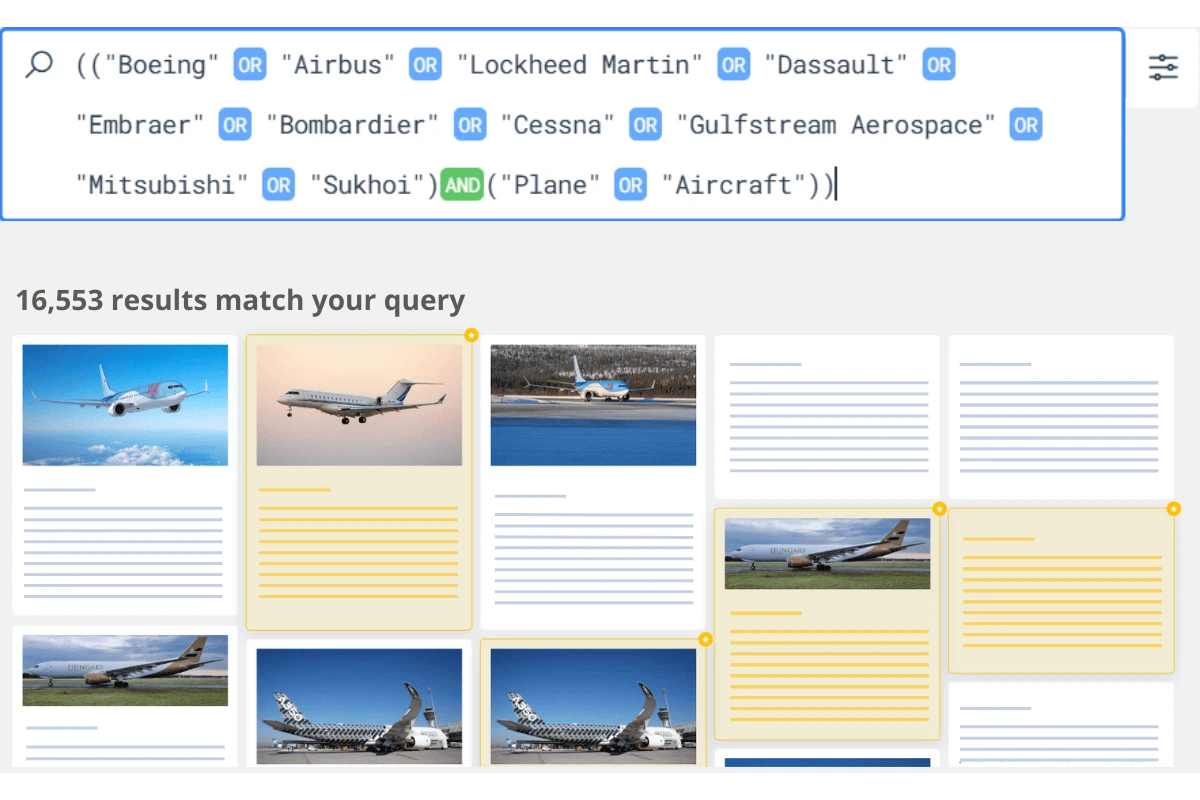
Automation doesn’t stop at data collection. It must also include filtering mechanisms.
You can:
These filters enable you to transform raw data into actionable insights.
To improve the overall performance of your analysis, explore our ebook on the information analysis process.
Artificial intelligence now plays a key role in striking a balance between automation and quality. It does not merely collect information: it enables that information to be analyzed, organized and made directly usable.
In practical terms, AI can be deployed as early as the processing phase by:
This classification process transforms a raw data stream into organized, prioritized and immediately actionable intelligence.
But the contribution of AI goes even further, particularly in the production of deliverables. It facilitates the transformation of information into high-value-added content by:
The result: deliverables are clearer, more consistent and, above all, much quicker to produce.
AI does not replace human expertise but acts as a powerful accelerator. It allows monitoring teams to focus on what really matters: analysis, interpretation and decision-making.
Even with the best tools, market intelligence cannot be fully automated. Human expertise remains essential. It is needed to provide context and verify the relevance of information as well for instance.
Automation should therefore be seen as a support, not a replacement.
With this in mind, features such as Ask Mila enable us to go further. Using artificial intelligence, Ask Mila helps to quickly query the information collected, extract key insights and speed up analysis, while maintaining human control over interpretation.
Discover how to use AI for your monitoring with our dedicated Ask Mila ebook, Cikisi’s generative AI developed for business intelligence.
Effective monitoring is monitoring that evolves. It is essential to regularly assess the performance of the system.
Some useful indicators:
This data enables us to adjust queries, sources and filters to continuously improve quality.
Automating market intelligence without compromising on quality is not only possible, but essential. By structuring your system correctly, selecting the right sources and incorporating human expertise, it is possible to turn market intelligence into a genuine strategic asset.
This is precisely the approach taken by Cikisi. By combining advanced automation, fine-tuned query settings and analytical tools, the platform enables market intelligence professionals to increase their efficiency while maintaining a high level of relevance.
Automation does not replace human intelligence: it enhances it. With the right tools, it even becomes a sustainable competitive advantage.



 Book a demo