

News and media
26 Feb 2026
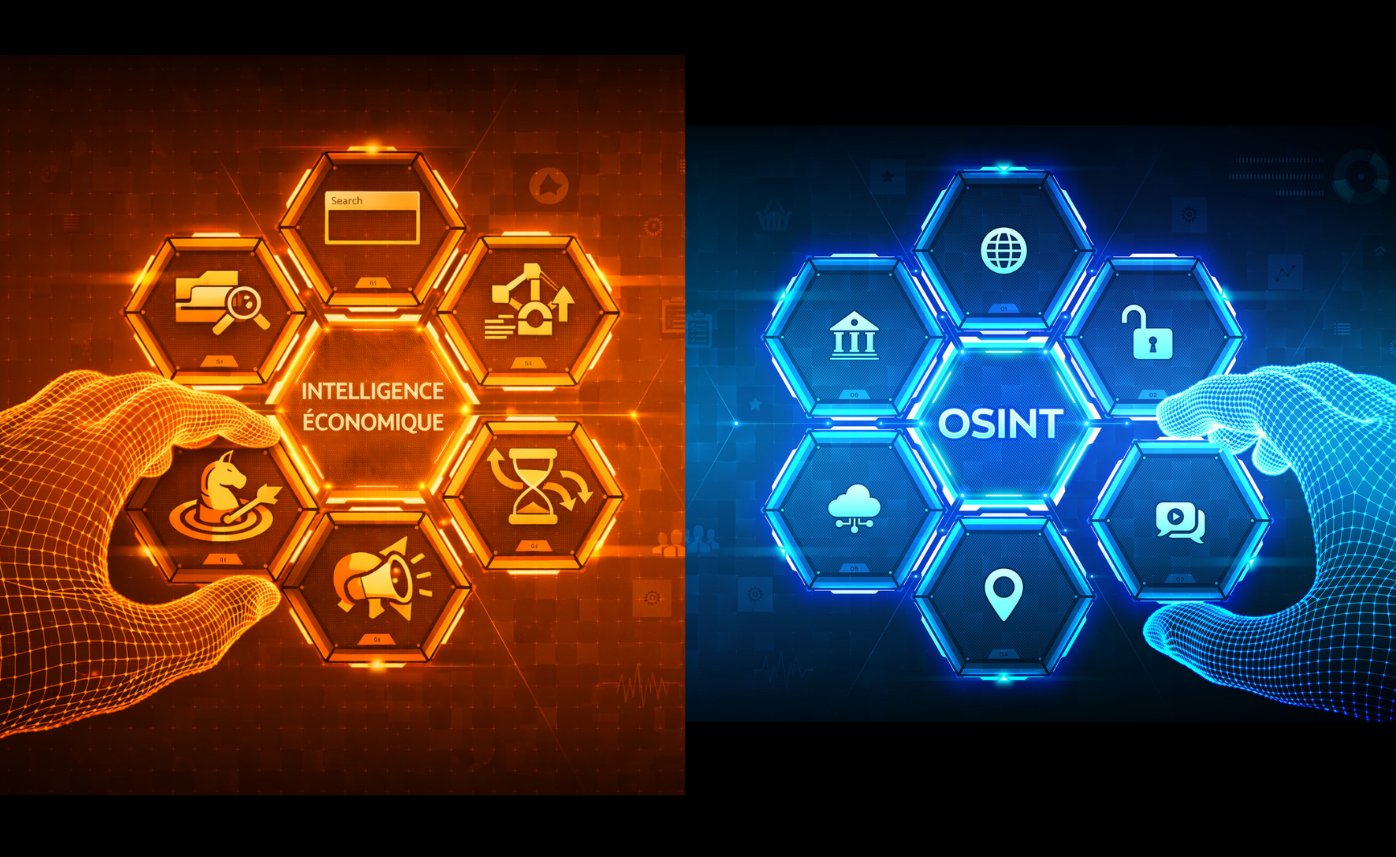
In a context of information overload, companies have never had access to so much data about their markets, competitors or regulatory environment. However, this abundance often creates more confusion than clarity.
Two concepts frequently used interchangeably emerge in this context: OSINT and economic intelligence. Often used as synonyms, they nevertheless cover very different realities. Understanding the distinction between them is essential for structuring a monitoring approach that is truly useful for decision-making.
OSINT (Open Source Intelligence) refers to all methods used to collect and analyze legally accessible information, whether public or not indexed by traditional search engines.
1. “Traditional” open sources
2. Deep Web
In contrast to the visible web, the deep web includes information that is legally accessible but not indexed by search engines:
Why is this important for companies?
The deep web is full of strategic signals that are often overlooked, yet they are very useful for:
Integrating the deep web into your OSINT monitoring allows you to move from “surface-level” monitoring to exhaustive monitoring, which ultimately forms the essential basis for economic intelligence.
Economic intelligence (EI) goes much further. It is a structured and continuous process aimed at collecting, analyzing, disseminating and protecting strategic information that is useful for the competitiveness and decision-making of the company.
Traditionally, economic intelligence is based on three pillars:
1. Strategic monitoring (competitive, technological, regulatory, market…), including OSINT, which is enriched by the deep web, is a key component.
2. Protection of informational assets to secure sensitive information and prevent leaks.
3. Influence and strategic communication in order to impact the business environment (standards, ecosystems, image).
The purpose of economic intelligence is not to accumulate information, but to transform that information into actionable knowledge and then into concrete decisions.
As opposed to OSINT, which is often carried out by individuals or experts, EI is a collective approach designed to feed the entire organization: senior management, sales teams, innovation, marketing or strategy.
👉 Where OSINT answers the question « what do we know? », economic intelligence answers « what should we do? ».
| Level | Main objective | Examples of activities | Result for the firm |
| OSINT | Collect legally available information | – Research on websites and public databases – Exploration of the deep web – Monitoring of social media and forums | Raw data or reliable but isolated information |
| Strategic Intelligence | Organize and make sense of the information | – Filtering and prioritization of sources – Analysis and contextualization of information – Dissemination to relevant teams | Actionable knowledge for decision-making |
| Economic Intelligence | Exploit the information to anticipate and act | – Capitalization of knowledge – Protection of informational assets – Influence and management of strategy | Informed decisions, anticipation of opportunities and risks |
In many organizations, market intelligence exists… but in a fragmented way:
The challenge is therefore no longer the access to information, but its common use, qualification and dissemination at the right time to the right people.
This is where economic intelligence makes perfect sense: it transforms a multitude of weak signals into a shared and actionable vision.
At Cikisi, we consider information to be a strategic raw material. That said, it must be:
The aim is not only to collect open data or data from the deep web, but also to structure it, qualify it, and incorporate it into a collective dynamic. Thanks to an approach focused on the quality of sources, the comprehensiveness of content, and the capitalization of analyses, OSINT becomes a real lever for economic intelligence.
OSINT and economic intelligence don’t compete with each other. Both are part of an information value chain:
In an uncertain and competitive economic environment, it is not the quantity of information collected that makes the difference, but the ability to transform individual monitoring into reliable collective intelligence that can be exploited by the entire company.
💡 In short
Cikisi is not just a monitoring tool or a simple OSINT engine. It is a platform that links comprehensive information gathering with strategic transformation, embodying both OSINT and economic intelligence. We can say that Cikisi transforms raw informational material into actionable and shared knowledge, exactly where OSINT and economic intelligence converge.

 Book a demo