
News and media
28 Oct 2026

Trade restrictions, new environmental obligations, export controls, changing rules on personal data… Regulatory decisions taken on the other side of the world can have a direct impact on your business. For companies operating internationally, being able to detect them in time has become a strategic issue.
A new restriction on raw material exports, a change in customs duties, an additional environmental obligation or a change in the rules on personal data transfers: all of these decisions can alter the conditions under which a commercial or industrial business operates.
Their consequences can be very concrete: higher procurement costs, a supplier called into question, production delays, an obligation to rethink a product’s composition, a loss of competitiveness or difficulty accessing a market.
For companies operating in several international markets, the challenge is twofold. They must keep track of a constantly changing regulatory environment, while monitoring information sources that are numerous, scattered and published in very different languages.
The risk is not only being unaware of a regulation. Above all, it is failing to detect in time that it has changed, been postponed, been extended or come into force.
Two recent examples clearly illustrate the importance of regular monitoring.
China’s restrictions on rare earths. In October 2025, China announced an expansion of its export controls on several rare earths and on technologies related to their processing. Some of these new measures were then suspended until 10 November 2026. On the eve of that deadline, Beijing announced a further extension of the suspension until 10 January 2027. However, some earlier restrictions remain in force. For manufacturers in the automotive, electronics and defence sectors, following these successive announcements is essential to anticipate supply risks.
The EU Carbon Border Adjustment Mechanism (CBAM). Having entered its definitive phase on 1 January 2026, it imposes new obligations on European importers of carbon-intensive products. Its scope and procedures continue to evolve, notably with discussions on extending it to certain processed products. For the companies concerned, these changes can affect import costs, supplier relationships and purchasing decisions.
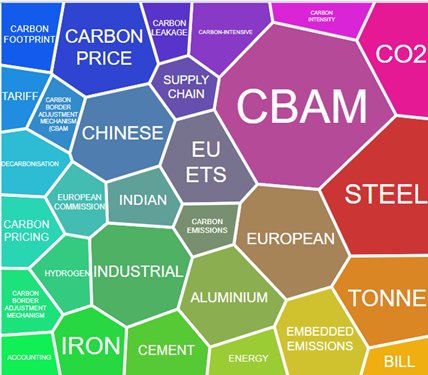
(screen copy Cikisi automatic analysis of the CBAM).
These two situations illustrate a key point: effective regulatory monitoring cannot be limited to detecting an initial publication. It must follow the successive developments of a case, sometimes over several years, and flag each new piece of information that could change the situation.
Critical information is not necessarily published in the language of the teams who need to use it.
A decision by the Chinese Ministry of Commerce may be published in Chinese. A US regulatory change may be issued by a federal agency. A new European obligation may be published in several official languages.
Limiting yourself to French- or English-language sources therefore means narrowing the scope of your monitoring and running the risk of missing important information.
Effective international regulatory monitoring must rely on several complementary capabilities:
The quality of monitoring therefore depends as much on the relevance of the information collected as on the coverage of sources and the regularity with which they are monitored.
Collecting a large volume of international information is not enough. You also need to be able to read it, qualify it and quickly extract what is useful.
This is where Cikisi’s AI agents add a new dimension to regulatory monitoring.
Customisable according to business needs, the topics monitored and the criteria defined by the company, they can work directly on the collected content to automate part of the document analysis work.
In particular, they can be configured to:
The aim is to significantly reduce the time needed to identify and understand relevant information.
Rather than asking several employees to read sometimes long and complex documents individually, teams have an initial structured analysis that directly highlights the points that concern them.
This time saving is collective: specialists can focus on analysis and validation, while operational teams get faster access to the information they need to make decisions.
Artificial intelligence does not replace legal or regulatory expertise. It makes that work easier and speeds up the flow of information to the people who need to act.
This marks a shift from individual document monitoring to collective, structured and directly usable regulatory intelligence.
International regulatory monitoring requires control of the entire information chain: from identifying sources to distributing relevant information, including multilingual collection, translation and automated analysis.
This is precisely the approach taken by Cikisi.
Thanks to its proprietary crawler, Cikisi gives you control over information collection across a wide range of web sources, including international and multilingual sources.
Its cross-language search capability makes it easier to identify relevant content regardless of the language in which it is published. Translation and customisable AI agents then make it possible to extract useful data, highlight important passages and make them easier to use.
Finally, continuous monitoring and alert mechanisms make it possible to track changes over time and share information with the employees concerned.
Information is no longer simply collected and stored. It is qualified, enriched and made available to the right people to speed up understanding and action.
In an international business environment, a regulation is never an isolated piece of information. It is part of a succession of publications, consultations, decisions, amendments and implementing measures.
The examples of the CBAM and China’s restrictions on rare earths show that critical information can change several times within a few months, or even a few days.
For companies, the ability to monitor these developments continuously is a real issue of competitiveness and risk management.
Detect earlier. Understand faster. Share better. Decide in time.
That is the full value of structured international regulatory monitoring, augmented by artificial intelligence.

 Book a demo