

AI
10 Aug 2026
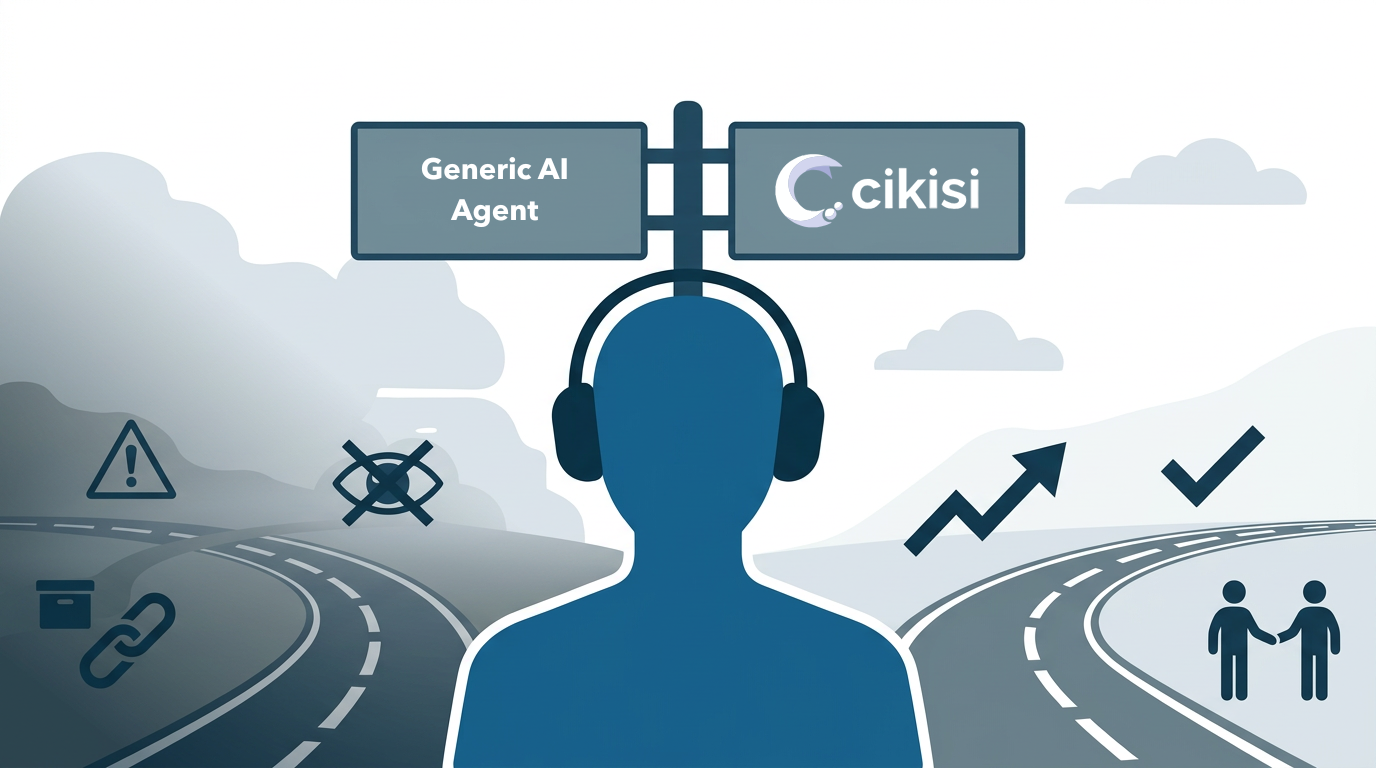
The Real Difference Between Automated Web Search and Intelligence Infrastructure
The widespread adoption of AI agents is shifting value towards data, coverage, memory, governance, and integration capabilities.
Generative AI is transforming strategic intelligence. A new generation of vendors is offering agents capable of searching the Web, analyzing information, and automatically producing summaries or newsletters. At the same time, many IT departments are developing their own agents, attracted — quite rightly — by their ease of use and automation capabilities.
This article is not about artificially positioning intelligence platforms against AI. It addresses a question that is increasingly being asked by organizations: can an autonomous Web-connected agent, on its own, replace a professional intelligence infrastructure?
Our answer is no. AI agents can automate some intelligence use cases, but they do not replace control over data collection, continuous monitoring, historical depth, or the legal and information governance required to build reliable strategic intelligence.
Since its creation, CIKISI has used AI to collect, enrich, search, validate, analyze, and distribute information. The relevant comparison is therefore not between an AI-powered solution and a platform that does not use AI. It is about the data AI can access, the part of the Web it can actually observe, the confidentiality of searches, and the information asset that remains under the company’s control.
The key question is no longer:
“Does the solution offer AI agents?”
It is:
“What data do those agents work with, what can they actually observe, and what knowledge remains with the organization?”
The building blocks required to create AI agents are now widely available: large language models, agentic frameworks, RAG architectures, natural-language search, entity extraction, automated categorization, and report generation.
An organization with an AI system connected to the Web can quickly produce an analysis, briefing, or newsletter around a given topic.
This provides genuine operational value. However, it is no longer, by itself, a sustainable competitive advantage.
When a system relies primarily on ad hoc Web searches, a limited selection of results, and processing by a language model, differentiation lies less in the generation itself than in the underlying corpus, coverage, traceability, and continuity of observation.
Organizations therefore need to assess what their system provides beyond orchestration:
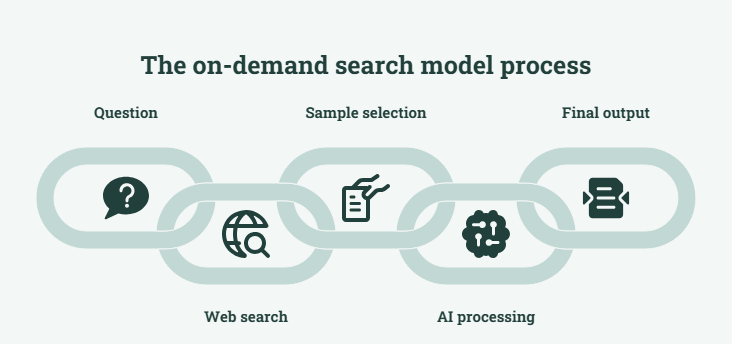
Question → Web search → selection of a sample → AI processing → answer or summary
Even with a highly capable agent, analysis can only cover the documents that are actually retrieved and selected.
The result remains dependent on the wording of the query, the ranking mechanisms of the search engine being used, the number of accessible results, and the system’s ability to surface less visible sources.
A well-written summary can therefore create an impression of completeness without demonstrating that the underlying information landscape has been sufficiently covered.
Like a puzzle, the quality of the interpretation cannot compensate for pieces that were never collected in the first place.
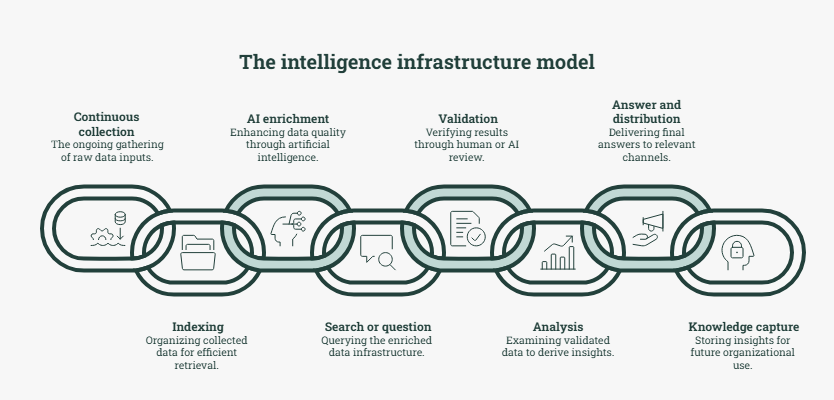
Continuous collection → indexing → AI enrichment → search or question → human or AI validation → analysis → answer and distribution → knowledge capture
CIKISI follows a different logic depending on the use case: continuous monitoring, on-demand search, or exploration.
In every case, information is first collected, indexed, and enriched. Questions, analyses, and summaries then operate on a corpus that is already structured, historical, and tailored to the client’s specific business needs.
CIKISI has developed its own crawler, its own independent Web index, and its own enrichment pipeline, independently of third-party services that may also be used to discover content.
This combination of a proprietary crawler, independent Web index, continuous enrichment, and a customer intelligence environment represents a particularly uncommon architecture in the European market.
Over time, customers build an information asset consisting of content collected in their Customer Web Data Lake, documents validated in their Customer Knowledge Base, taxonomies, validation rules, and the knowledge contributed by their experts.
Continuous collection significantly reduces blind spots and improves the representativeness of the corpus available for analysis.
A weak signal is, by definition, difficult to detect, rarely cited, and often scattered across multiple sources.
It may appear in a specialist publication, remain absent from the first results returned by a general-purpose search engine, or only become meaningful after several seemingly unrelated events are connected over time.
Regardless of how sophisticated an AI system is, it can only analyze the documents it can access.
If information is not present in the retrieved results or in the sample provided to the agent, the agent cannot identify it, contextualize it, or connect it to other events.
Weak signals are therefore particularly likely to be missed when analysis relies on a one-off sample of search results.
By contrast, continuous collection and historical depth make it possible to identify shifts, gradual changes, emerging players, anomalies, and unexpected correlations.
Two agents using the exact same underlying model can produce very different results depending on whether they analyze a handful of instantaneous search results or a corpus that has been continuously enriched and historized over several years.
When it comes to weak signals, the question is not which agent appears more intelligent.
The question is how much of the information landscape it can actually observe.
A Web-connected agent is primarily designed to answer a question.
An intelligence system must also help an organization discover what it did not yet know it needed to look for.
It must be able to:
Search answers an immediate request.
Intelligence builds continuous memory and knowledge.
CIKISI makes this knowledge accessible not only to its own analytical capabilities, but also to the organization’s information systems and AI assistants through its APIs and MCP server.
Autonomous agents developed by organizations are not natural competitors to CIKISI.
Connected through CIKISI’s MCP server to the information assets collected, enriched, structured, and historized within the platform, they can access a much richer external context for their analyses.
In comparative tests conducted by CIKISI, responses and summaries generated with access to the CIKISI corpus proved more relevant, better documented, and more comprehensive than those produced by the same agents relying solely on their other Web access points.
The test conditions, evaluation criteria, and results can be provided upon request.
Do not ask your agents to reconstruct the Web every time they receive a question. Connect them to an information asset that has already been collected, enriched, and governed.
Since its creation in 2016, CIKISI has placed AI at the core of its architecture.
The platform developed early capabilities for semantic search, natural-language querying, and retrieval-augmented generation independently of third-party services.
Today, generative AI is used through specialized agents designed for specific tasks, including:
CIKISI is also developing agentic capabilities tailored to specific business use cases, such as opportunity identification and company profiling.
We do not question the usefulness or simplicity of AI agents.
We simply believe that their widespread adoption is shifting value towards data, coverage, memory, governance, and integration capabilities.
The subject being monitored is often more sensitive than the information ultimately retrieved.
A search relating to an acquisition, a technology under development, a competitor, a vulnerability, or a tender can reveal an organization’s strategic intentions.
CIKISI relies on its own crawler, Web index, enrichment pipeline, and self-hosted generative AI models.
The solution is hosted on dedicated OVH infrastructure located in France. This architecture is designed to avoid transmitting customers’ monitoring topics to external services and to maintain control over the processing chain.
When a provider does not operate its own Web index, it should clearly explain which search engines, APIs, content brokers, or third-party services are used to discover and retrieve information.
Hosting an application in a sovereign environment does not, by itself, demonstrate sovereignty across the entire information-processing chain.
Organizations should ask which models, search engines, APIs, and subcontractors are involved; where processing takes place; whether data is transferred outside the European Economic Area; and whether queries or results can be stored or reused.
Finding and analyzing information does not automatically mean that an organization is entitled to reproduce, retain, or distribute it.
In France, the use of press content in intelligence services is governed in particular by copyright, related rights, and applicable licensing agreements.
The Centre français d’exploitation du droit de copie (CFC) states that its “Veille web” license covers the crawling, extraction, reproduction, and indexing of press content, as well as making such content available to corporate customers through links or analyses.
In the list published by the CFC on March 19, 2026, CIKISI is among the platforms that have signed this license.
At the time this list was consulted, newer solutions offering autonomous agents did not appear on it.
This absence does not establish that such solutions have no agreements directly with publishers or rely on other legal mechanisms. It does, however, mean that organizations should ask each provider to clearly specify the rights it holds to collect, index, retain, analyze, and distribute press content.
Source : CFC, licensed information monitoring platforms
The question is straightforward:
Under what legal conditions can content be collected, indexed, retained, analyzed, and distributed within my organization?
| # | Governance question |
|---|---|
| 1 | What part of the Web does the agent actually observe? How confident are we that our business environment is sufficiently covered, including corporate websites and other relevant sources? Can the coverage be expanded or adapted? |
| 2 | Which search engines or APIs does the agent depend on? What are their names, jurisdictions, and data locations? |
| 3 | Is information collected continuously or only when a question is asked? How can we ensure that the agent has access to the latest publicly available information? At what frequency? |
| 4 | Beyond the answers themselves, does the organization retain a long-term, searchable history of collected information? |
| 5 | Are expert validations captured and reused? Does the agent provide a way to assess the reliability or relevance of a source based on how it has been used and validated by the organization? |
| 6 | Where do queries travel, and which providers may be able to see the topics being monitored? Where are the generative AI models used by the agent hosted? |
| 7 | What rights allow the organization to collect, reproduce, retain, analyze, and distribute the content? |
| 8 | Can the agent connect, through an API or MCP, to the organization’s existing information assets? |
AI agents will fundamentally transform strategic intelligence.
They make data easier to query, accelerate analysis, and automate an increasing share of intelligence deliverables.
But they do not eliminate the need to observe the information landscape, retain information, structure knowledge, protect strategic searches, or control content usage rights.
The future is therefore not about choosing between autonomous agents and intelligence platforms.
It is about organizations that can connect their agents to an external, continuous, historical, and governed information infrastructure.
This is precisely the role CIKISI aims to play: providing intelligence professionals — as well as enterprise-built AI agents — with the information they need to understand, detect, and anticipate.
An agent can only analyze what it can observe. Our role is to give it access to the broadest, most structured, and most reliable information landscape possible.
Valéry Mainjot, CEO of CIKISI | September 21, 2026

 Book a demo