News and media
28 Oct 2026
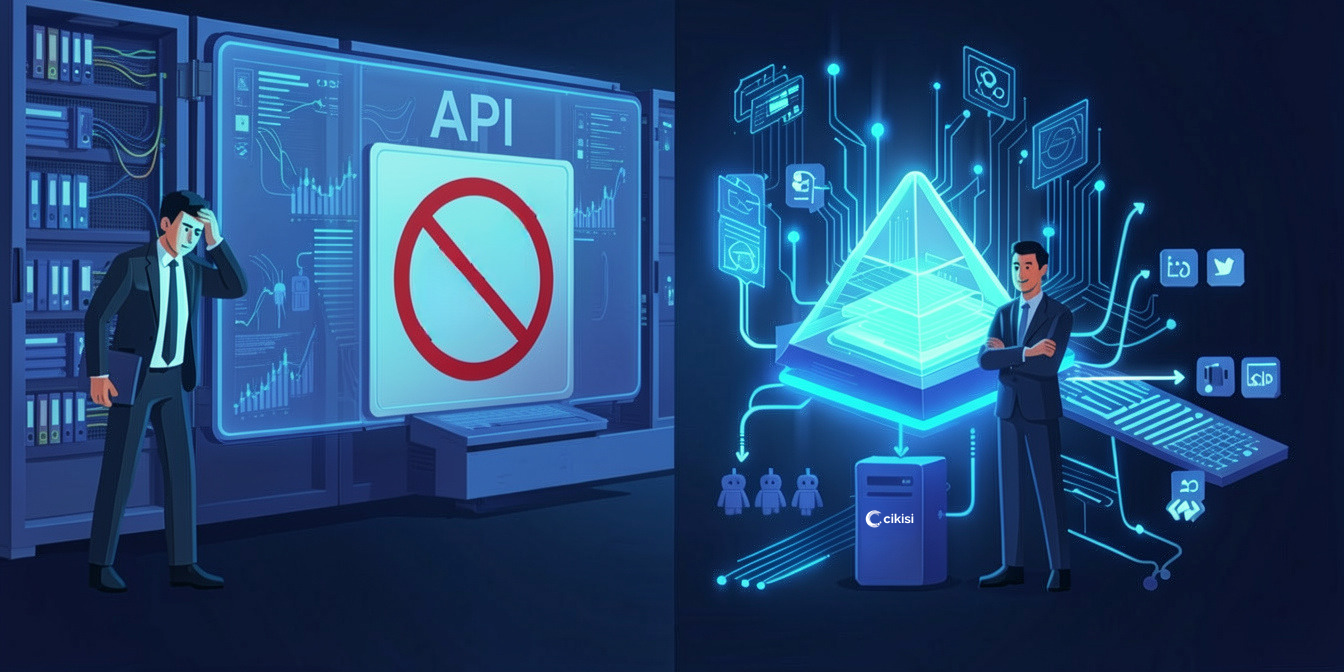
Search APIs are gradually being shut down. Major tech companies are tightening control over their infrastructure. In this context, businesses must assess their dependence on external information sources and their ability to control their own information supply.
Microsoft discontinued its Bing Search APIs in August 2025. Google has closed its Custom Search JSON API to new customers and is preparing to phase out the service for existing users.
Behind these decisions lies a profound shift in the market: access to web data is becoming more controlled, more regulated, and more deeply integrated into the proprietary ecosystems of major tech companies.
These developments are particularly tied to the advancement of artificial intelligence. Web indexes represent a significant asset for feeding AI models, agents, and response engines. It is therefore in the major players’ interest to exert greater control over the terms of access to these resources and to prioritize integrated services over the distribution of raw results. For solution providers and end-user companies, this means increased dependence on infrastructures whose access terms, pricing, and features can change at any time.
Before analyzing, comparing, detecting weak signals, or generating recommendations, you need high-quality raw data. That is the whole point of an AI-ready web intelligence infrastructure one capable of providing both analytics and AI agents with reliable, curated data.
However, information that is incomplete, outdated, or drawn from too few sources undermines the entire analysis process—even when it relies on the most advanced artificial intelligence technologies.
Relying exclusively on search engines or external API providers carries several risks:
The solution isn’t simply to increase the number of API providers. It lies in the ability to build and control your own data collection infrastructure.
Cikisi has developed its own technology for collecting and indexing information, based on several types of complementary bots, including indexing bots and intelligent bots.
Our indexing bots crawl the web and collect content from identified sources. Our intelligent bots go a step further: they help discover new sources of information, expand the scope of collection, and continuously enrich the data sources.
This complementary approach is essential. It allows us not only to monitor already known sources but also to discover new repositories of information and identify relevant sources that had not yet been indexed.
Effective monitoring should not be limited to tracking what we already know. It must also enable us to discover what we did not yet know.
This technological expertise reduces dependence on general-purpose indexes and external search APIs, while maintaining the ability to explore and collect content tailored to the specific needs of each company.
Effective data collection truly shines when the information can be leveraged beyond the monitoring platform itself.
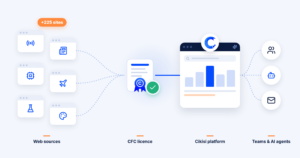
Through its APIs and MCP server, Cikisi enables the integration of collected data into business applications, information systems, and corporate artificial intelligence environments.
Teams and AI agents can thus access structured raw data tailored to their needs, within the access and usage policies defined by the company.
Access to public information does not automatically mean that its automated collection, storage, or reuse are free from any restrictions.
In particular, companies must take into account copyright law, database rights, website terms of use, the GDPR, and any access restrictions.
Compliance must be built in from the very design of data collection systems: identification and traceability of sources, access management, respect for rights, and control over reuse conditions.
Technological expertise does not replace legal expertise. The two are inseparable when building a sustainable information infrastructure.
Artificial intelligence is profoundly transforming the ways we use information. But it does not solve the fundamental issue of how that information is sourced.
A high-performing model fed with incomplete data will not produce reliable intelligence.
At a time when major tech companies are tightening their control over their infrastructure, businesses have every reason to regain control of their information chain: diversifying their sources, developing their data collection capabilities, discovering new sources of information, and ensuring the quality and traceability of their data.
| Information is the raw material of intelligence. The ability to discover, collect, and manage it constitutes a true competitive advantage. |

 Book a demo