

AI
10 Aug 2026
Competitive and strategic intelligence relies on a proven methodology: the intelligence cycle. Originally developed in the military intelligence sphere and later adopted by businesses, it has always followed the same core stages: identifying needs and sources, collecting information, processing and selecting it, and finally distributing it to the right people.
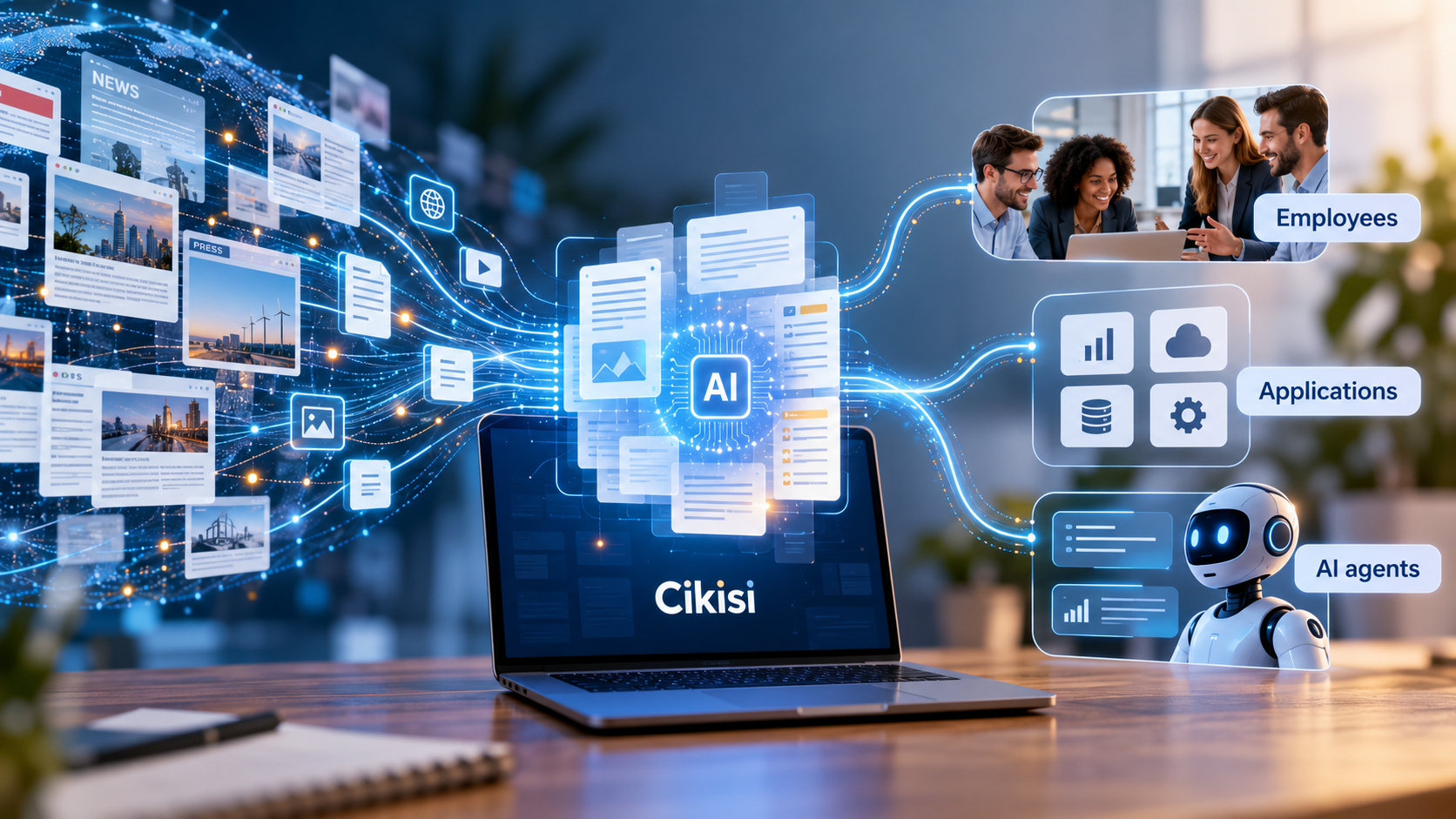
Artificial intelligence is now transforming every stage of this cycle. It makes it possible to explore the Web more broadly, qualify and transform collected information, automate the continuous flow of intelligence, and, above all, make that intelligence accessible to the company’s tools, applications, and AI agents.
The challenge is therefore no longer simply to monitor information. It is to turn the vast amount of information available on the Web into intelligence that can be used across the entire organization.
This is what we call Enterprise Web Intelligence: the ability to continuously explore the Web, qualify information, and make it actionable for employees, applications, and AI agents across the enterprise.
Here is how we get there, in six steps.
Starting intelligence work on a new topic often means starting with a blank page. Who are the key players? Which technologies are emerging? Which startups should be monitored? Which sources actually matter?
This is the role of exploratory intelligence: rapidly understanding a new information landscape before its monitoring scope can even be precisely defined.
With Cikisi’s Smart Bots, exploration does not depend on a predefined list of sources. The bots navigate the Web according to the context of the topic being explored. They discover new sources and move through an information ecosystem that evolves as the exploration progresses.
Take a company looking to identify businesses working on an emerging technology it does not yet fully understand. The bots can explore the Web broadly around that technology, while the collected content is then sorted and filtered to identify relevant companies.
The result is a map of potential future partners or even acquisition targets without the company needing extensive prior knowledge of the field.
But collection alone is not enough. The value of this information depends on our ability to qualify it.
Once collected, information needs to be processed. Our AI agents intervene at different stages of the process to qualify, filter, and transform raw information.
Depending on the use case, they can:
The objective is not to increase the volume of information, but to make it more relevant, structured, and easier to use.
This is the shift from information collection to genuine information intelligence.
Once the scope has been defined, another question arises: how can this knowledge be kept up to date without requiring teams to constantly intervene?
This is where Mila+ comes in.
Mila+ automatically feeds intelligence environments with new content matching the defined monitoring scope. Intelligence is no longer a succession of one-off searches. It becomes a continuous flow.
The organization moves from exploring a topic to monitoring it—and then to continuously updating its knowledge.
Relevant information only has value if it is used. Cikisi immediately distributes content and monitoring results through the company’s usual channels: portals, alerts, newsletters and other distribution mechanisms.
This step ensures that the right information reaches the right people, but it remains focused on the reader. Yet, in the digital enterprise, the users of information are no longer only employees. They are also applications, business systems and, now, AI agents. This is where scaling begins.
Thanks to APIs and MCP (Model Context Protocol, the standard that allows AI agents to access external tools and data), the information produced by monitoring systems moves beyond the consultation environment alone. It can be integrated into other tools, applications or AI environments.

The model evolves
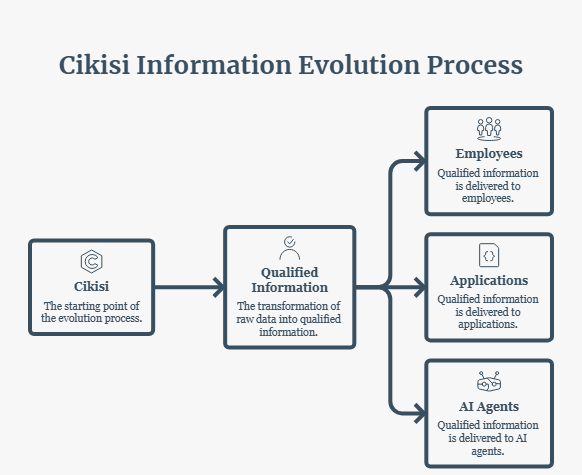
Monitoring can then feed the company’s digital processes, beyond simply informing people. An analyst queries a structured document corpus. An AI agent relies on qualified information to answer a business question. An application automatically retrieves the data it needs.
A concrete example: an industrial company wants to detect, at an early stage, industrial construction projects likely to generate commercial opportunities. The bots explore the Web broadly to identify these projects from their earliest signals, the AI agents qualify each of them, and the results are then made available to sales teams in their working environment. The result: 100% of the leads identified were found to be compatible with the company’s offering, after validation by the sales teams.
The information becomes accessible across the entire information system.
This evolution naturally brings monitoring closer to Knowledge Management. The aim is to progressively build a living information asset: collect, qualify, structure, enrich, update, make accessible and reuse.
The value does not lie solely in each individual piece of information. It also lies in the company’s ability to maintain, leverage and circulate this knowledge over time.
The Web is becoming a continuous source of information for the enterprise. Smart Bots explore it, AI agents qualify and transform it, Mila+ automates its feeding, distribution channels make it immediately accessible, and APIs and MCP enable applications and AI agents to use it.
The intelligence cycle, inherited from the military sphere, thus becomes a continuous loop connected to the entire enterprise. Monitoring takes the form of an intelligence infrastructure.
The objective is to reduce the time required to move from information to understanding, from understanding to knowledge, and from knowledge to action.
This is where, for Cikisi, the challenge of Enterprise Web Intelligence lies.
Turn Web information into qualified intelligence that is continuously updated and directly accessible to your employees, applications, and AI agents.
Discover how Cikisi can connect your intelligence workflows across your organization and accelerate the journey from information to action.
 Book a demo